If you have been tracking your sleep with a wearable for months and still feel exhausted, you may have reached the limit of what consumer technology can tell you. Sleep trackers and sleep studies are not competing tools — they operate at different levels of resolution and serve fundamentally different purposes.
A sleep tracker helps you understand your sleep patterns and optimize what you are doing. A sleep study diagnoses medical conditions that no amount of optimization will fix. Knowing which one you need is not always obvious, but the distinction matters enormously — especially if you have an undiagnosed sleep disorder.
Overview
Consumer sleep trackers have become impressively capable. Modern wearables measure heart rate variability, body temperature, blood oxygen, movement, and respiratory rate — and use this data to infer sleep stages with reasonable accuracy. They are excellent tools for monitoring trends, motivating better habits, and flagging potential problems worth investigating further.
Sleep studies — formally called polysomnography, or PSG — do something entirely different. They measure the brain’s electrical activity, eye movements, muscle tone, airflow, blood oxygen, and limb movements simultaneously, in a controlled clinical environment. This level of physiological data is the only way to definitively diagnose conditions like obstructive sleep apnea, REM sleep behavior disorder, narcolepsy, and periodic limb movement disorder.
The distinction is this: a tracker tells you something may be wrong; a sleep study tells you what is wrong.
What Consumer Sleep Trackers Measure
Modern wearables like the Oura Ring, Garmin, and Apple Watch use a combination of accelerometry and photoplethysmography (PPG) to capture the following:
- Heart rate variability (HRV) — a sensitive marker of autonomic nervous system state and recovery
- Resting heart rate — elevated resting HR correlates reliably with poor recovery and illness
- Movement — used to detect wakefulness and differentiate lighter from deeper sleep
- Skin temperature — fluctuations indicate hormonal changes, illness, or alcohol effects
- Blood oxygen (SpO2) — some devices flag potential desaturation events
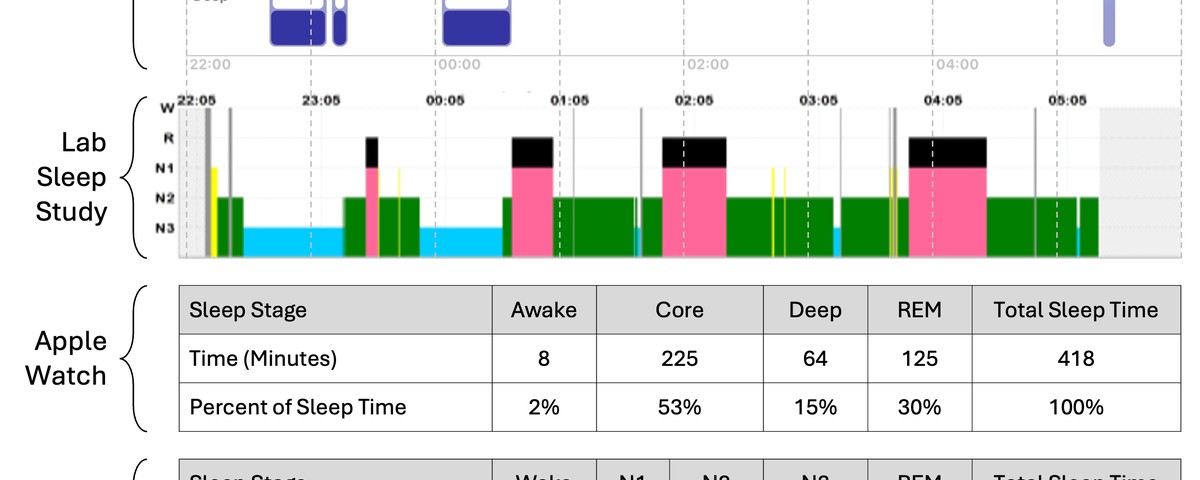
From this data, algorithms infer sleep stages. Independent validation studies comparing consumer trackers against polysomnography put overall accuracy at roughly 70–85% depending on the device and the specific metric being measured. Sleep stage classification — particularly distinguishing light from deep sleep — is the weakest point. Heart rate and HRV measurements are generally more reliable.
What trackers are genuinely good for:
- Monitoring sleep duration trends over weeks and months
- Identifying behavioral patterns (how alcohol, late meals, or stress affect your sleep)
- Motivation and accountability
- Flagging a potential problem — consistently low oxygen readings or fragmented sleep that warrants clinical follow-up
- Evaluating treatment progress after a diagnosis has been made
For a full guide to the best options on the market, see our best sleep trackers for 2026 roundup.
What a Sleep Study (Polysomnography) Measures
An in-lab polysomnography study involves sleeping at a clinical facility while connected to a comprehensive array of sensors. This is not an approximation — it is direct measurement of the brain and body during sleep:
- EEG (electroencephalography) — electrode arrays on the scalp record electrical brain activity, allowing precise staging of sleep (N1, N2, N3, REM)
- EOG (electrooculography) — eye movement sensors detect REM sleep definitively, not through inference
- EMG (electromyography) — muscle activity sensors on the chin and legs detect abnormal movement, including REM muscle atonia loss
- Airflow sensors — thermistors and pressure transducers at the nose and mouth measure actual airflow and detect apneas and hypopneas
- Pulse oximetry — continuous blood oxygen monitoring captures desaturation events in real time
- Respiratory effort belts — chest and abdominal bands distinguish obstructive from central apnea
- Leg movement sensors — detect periodic limb movements and restless legs activity
This data stream allows a sleep specialist to diagnose with clinical certainty:
- Obstructive sleep apnea (OSA) — the most common sleep disorder, affecting an estimated 1 in 4 adults, many undiagnosed
- Central sleep apnea — neurological failure to initiate breathing, as opposed to physical obstruction
- REM sleep behavior disorder (RBD) — loss of normal muscle paralysis during REM, causing people to physically act out dreams
- Narcolepsy — requires a Multiple Sleep Latency Test (MSLT) performed the day after PSG
- Periodic limb movement disorder (PLMD) — repetitive leg movements that fragment sleep without the person being aware
- Severe restless legs syndrome
In-lab vs at-home sleep testing: For suspected sleep apnea in patients without complicating factors, home sleep tests (HST) are now widely offered. These are simplified devices that measure airflow, respiratory effort, and blood oxygen without the full EEG component. They cost significantly less ($150–$300 vs $1,000–$3,000 for in-lab PSG) and are sufficient for diagnosing moderate-to-severe OSA. However, they cannot diagnose RBD, narcolepsy, PLMD, or other conditions that require brain wave monitoring.
Accuracy Comparison
| Metric | Consumer Tracker | Polysomnography |
|---|---|---|
| Sleep stage accuracy | ~70–85% overall; weakest on N3 vs N2 distinction | Gold standard — definitive |
| Apnea detection | Can flag low SpO2; cannot count apneas accurately | Counts apneas per hour (AHI); diagnostic standard |
| Bruxism detection | Not detected | Detected via EMG with appropriate setup |
| REM behavior disorder | Cannot detect | Definitively diagnosed via EEG + EMG |
| Leg movements | Motion sensors may capture gross movements | Precisely measured per hour |
| Narcolepsy | Cannot diagnose | Diagnosed via MSLT following PSG |
| Cost | $200–$600 device + subscription | $150–$300 (HST); $1,000–$3,000 (in-lab) |
When a Sleep Tracker Is Enough
A consumer tracker handles most of what the average person actually needs. Specifically, a tracker is the right tool if:
- You want to optimize healthy sleep. Tracking sleep duration, HRV trends, and the behavioral factors that affect your nights gives you everything you need to improve sleep that is fundamentally normal but could be better.
- You are monitoring trends over time. Gradual changes in HRV or sleep duration that correlate with life changes — new job, training load, dietary shifts — are well within a tracker’s capability to capture.
- You want accountability. The behavioral feedback loop alone is valuable. People who track sleep tend to prioritize it more.
- You are identifying patterns. Correlating alcohol, late caffeine, screen time, or late meals with sleep quality is something a tracker does genuinely well over a long data set.
- You have no symptoms suggesting a clinical disorder. If you feel rested, have normal daytime energy, do not snore loudly, and do not have a bed partner reporting alarming breathing, your sleep is likely not disordered.
When You Need a Sleep Study
This is where people underestimate the stakes. Sleep disorders — especially sleep apnea — are underdiagnosed at a population level, and consumer trackers have given many people false confidence that their sleep is fine because their app shows “good” scores.
Seek a clinical sleep study if any of the following apply:
- Snoring plus daytime sleepiness plus witnessed apneas. This is the classic triad for obstructive sleep apnea. If your partner has observed you stop breathing during sleep, this is a medical situation, not a sleep optimization question.
- Excessive daytime sleepiness that does not resolve with more sleep. Feeling sleepy after eight hours despite reasonable sleep hygiene warrants investigation.
- Acting out dreams during sleep. Punching, kicking, shouting, or physically moving during dreaming is a hallmark of REM sleep behavior disorder — a condition that requires clinical diagnosis and has important neurological implications.
- Restless legs or repetitive leg jerking that disrupts sleep. These may be treatable conditions; self-monitoring does nothing to address them.
- No improvement after three or more months of consistent sleep hygiene practice. If you have fixed your environment, schedule, and habits and you still cannot sleep, there may be an underlying disorder driving the problem.
- Your doctor suspects narcolepsy. Narcolepsy requires specific clinical testing — a standard tracker reading is meaningless for this diagnosis.
Do not let a sleep tracker score talk you out of seeing a doctor when symptoms are present. An Oura Ring or Apple Watch showing “good” sleep while you are waking up exhausted every morning is a flag, not reassurance.
The Smart Approach: Use Both
Consumer trackers and sleep studies are complementary, not competing.
Use a tracker to identify a potential problem. Consistently low SpO2 readings, extremely fragmented sleep, or a HRV trend that suggests chronically poor recovery can all be early signals worth taking to a doctor.
Use a sleep study to diagnose it. Once a clinical sleep disorder is suspected, only polysomnography provides the resolution needed for an accurate diagnosis and treatment plan.
Use a tracker to monitor treatment effectiveness. After starting CPAP therapy for sleep apnea, for example, tracking HRV and sleep fragmentation over time gives you real-world data on how well treatment is working between clinical follow-ups.
The two tools work best in sequence. A tracker surfaces patterns; a sleep study explains them.
Key Takeaways
- Consumer sleep trackers are useful for optimization, pattern recognition, and flagging potential problems — they are not diagnostic tools
- Polysomnography is the clinical gold standard and the only way to definitively diagnose sleep apnea, REM behavior disorder, narcolepsy, and PLMD
- Sleep apnea is significantly underdiagnosed; tracker “good sleep” scores do not rule it out
- Home sleep tests offer a lower-cost path to apnea diagnosis (~$150–$300) for uncomplicated cases
- If you have classic symptoms of a sleep disorder — loud snoring, witnessed apneas, unexplained daytime sleepiness, or acting out dreams — see a doctor rather than tracking longer
- The smartest approach is using a tracker to identify a potential problem and a sleep study to diagnose it