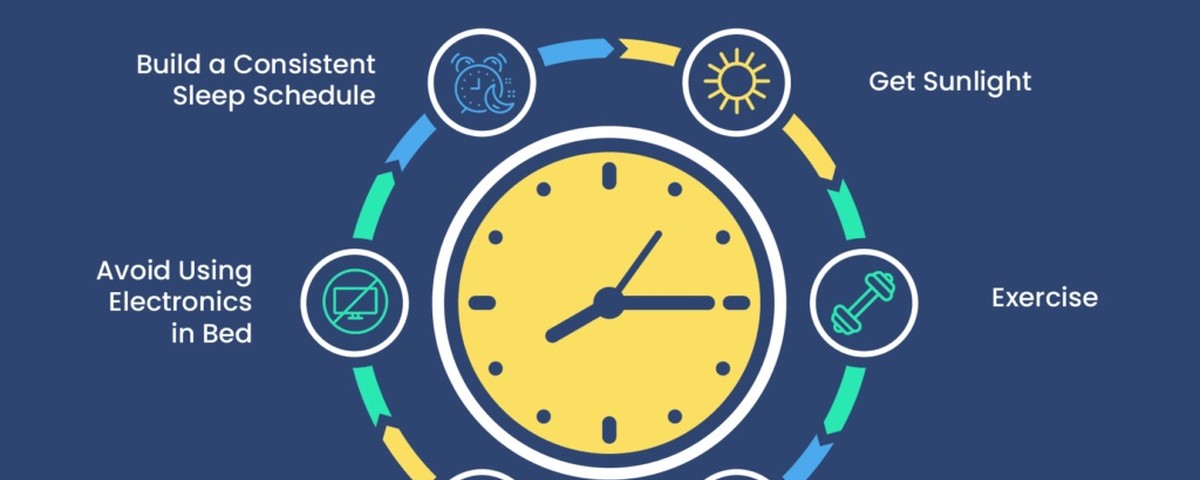
Your sleep quality is not determined only by what you do in the hour before bed. It is determined by signals you send your brain across the entire day — and by whether those signals are internally consistent. The circadian rhythm is the biological infrastructure underneath all of it. Understand it at the mechanistic level, and most sleep advice stops being a list of tips and starts making obvious sense.
What Is the Circadian Rhythm?
The circadian rhythm is the body’s internal timekeeping system, running on a cycle of approximately 24 hours. The word comes from the Latin circa diem — “around a day.” It is not a metaphor. You have a physical clock: a cluster of roughly 20,000 neurons in the hypothalamus called the suprachiasmatic nucleus (SCN). This structure coordinates the timing of nearly every biological process in your body — sleep onset, hormone secretion, body temperature, digestion, immune activity, and cell division.
The SCN’s timekeeping is endogenous, meaning it runs on its own. Place a human in a windowless room with no time cues, and the SCN will still cycle through roughly 24-hour periods. But the clock drifts slightly — the free-running period in most humans is approximately 24.2 hours — so it requires daily calibration from environmental signals called zeitgebers (German for “time-givers”). Light is by far the most powerful zeitgeber. Food timing, exercise, and social cues also play supporting roles.
Why did we evolve to sleep at night? The ancestral pressure was predation and energy conservation. Nighttime provided low foraging yield and high predation risk for early hominids. Consolidating inactivity into a predictable nocturnal window aligned metabolic repair with a period of enforced low activity. Crucially, this rhythm is conserved across virtually all multicellular life — from fungi to flies to humans — which tells you how deep in evolutionary history it goes and how costly it is to fight it.
The Science of Your Body Clock
Understanding four specific biological variables gives you a precise model of how your circadian system operates.
Melatonin is synthesized in the pineal gland from serotonin and released into the bloodstream in the hours after darkness. It is not a sedative — it is a timing signal. Melatonin communicates to the body that it is nighttime, facilitating the downstream cascade that enables sleep. Its release begins roughly 2 hours before your habitual sleep onset (a point called dim-light melatonin onset, or DLMO) and is suppressed almost instantaneously by light, particularly in the blue wavelength range (460–480 nm). A single lux of short-wavelength light can measurably suppress melatonin in a dark-adapted eye. This is not a subtle effect.
Cortisol operates in opposition. The SCN drives a surge of cortisol beginning roughly 30–45 minutes before your habitual wake time — the cortisol awakening response (CAR). This rise increases alertness, mobilizes energy, and begins preparing the body for activity. Cortisol should be at its daily peak within the first hour of waking and then decline steadily throughout the day. Chronic sleep deprivation, stress, and light-at-night disruption all flatten the CAR, which is one reason people with poor sleep feel genuinely foggy in the morning rather than simply tired.
Core body temperature (CBT) fluctuates by approximately 1–2°F (0.5–1°C) across the 24-hour cycle. Temperature reaches its nadir around 4–5 AM and its peak in the late afternoon, around 5–7 PM. Sleep onset is strongly facilitated by a falling CBT. The reason a warm bath 1–2 hours before bed improves sleep is precisely this: the bath draws blood to the skin surface, and the subsequent heat dissipation after you step out accelerates the core temperature drop.
The two-process model of sleep, developed by Alexander Borbély in the 1980s, remains the most useful framework for understanding sleep drive. Process S (homeostatic sleep pressure) is a chemical accumulation of adenosine in the brain that builds from the moment you wake up and is cleared only during sleep. Caffeine works by blocking adenosine receptors — it does not reduce adenosine, it masks it. Process C (the circadian process) is the alerting signal from the SCN that opposes Process S during the day, creating a window of high alertness despite rising sleep pressure. Sleep occurs when Process S overwhelms Process C — typically in the evening — and the ideal sleep window is the point where both processes are optimally aligned.
Circadian Rhythm and Sleep Stages
The timing of your sleep relative to your circadian phase determines not just whether you sleep, but what kind of sleep you get.
Deep sleep (NREM Stage 3, slow-wave sleep) is front-loaded. It is most abundant in the first two 90-minute sleep cycles of the night and is driven primarily by homeostatic sleep pressure (Process S). This is why going to bed significantly later than usual means you will still get deep sleep — your adenosine load is high regardless of clock time — but you will lose deep sleep if you cut the night short.
REM sleep is back-loaded and is governed more strongly by the circadian process than by homeostatic pressure. REM dominates the final cycles of the night, with the longest REM periods occurring in the last 90 minutes of sleep before your natural wake time. This is why truncating sleep by even 60–90 minutes — setting an earlier alarm, for example — disproportionately cuts REM, not deep sleep. You lose mostly the neurologically expensive, emotionally important stage.
The practical implication: you cannot re-order sleep architecture. You cannot take an early short sleep and compensate for lost REM with a nap, because naps during the biological day occur outside the REM-dominant circadian window. Total sleep duration, timed correctly, is the only reliable way to capture the full complement of both sleep stages.
What Disrupts Your Circadian Rhythm
Artificial light, especially blue light, is the most pervasive modern disruptor. The melanopsin-containing retinal ganglion cells that feed directly into the SCN are maximally sensitive to short-wavelength blue light. Overhead LED lighting, screens, and backlit devices all emit substantial blue-spectrum light. Evening exposure pushes melatonin onset later, delays sleep timing, and effectively signals “midday” to your brain’s clock — every night.
Irregular sleep and wake times are arguably more damaging than a consistently late schedule. The SCN synchronizes across multiple days of consistent timing cues. Variable sleep times give the clock contradictory signals and prevent stable entrainment. Even a single late night creates measurable circadian disruption visible in biomarkers the following day.
Shift work represents the most extreme form of circadian disruption. Night shift workers are attempting to sleep during the circadian-driven wake phase and work during the sleep phase. The health consequences are not trivial: shift work is a Group 2A carcinogen (probably carcinogenic to humans) per the International Agency for Research on Cancer, and is associated with elevated rates of metabolic syndrome, cardiovascular disease, and depression.
Jet lag is acute circadian misalignment caused by rapid geographic displacement across time zones. Eastward travel is harder than westward because it requires phase advancement (sleeping earlier) — the human clock, with its natural tendency to run slightly longer than 24 hours, advances more slowly than it delays. Recovery typically takes one day per time zone crossed.
Meal timing carries its own circadian signal through peripheral clocks in metabolic organs — particularly the liver, pancreas, and gut. Eating large meals late at night sends a conflicting “daytime” signal to these peripheral clocks while the central SCN is in its nocturnal phase. This misalignment — termed circadian metabolic uncoupling — is associated with impaired glucose tolerance, weight gain, and poorer sleep quality. Time-restricted eating aligned with daylight hours substantially reduces this misalignment.
Social jetlag describes the chronic discrepancy between your biological clock and your social schedule. Most people sleep later on weekends than on weekdays, creating a weekly cycle of circadian misalignment and re-alignment. Research by Till Roenneberg at Ludwig Maximilian University of Munich found that the average social jetlag in industrialized populations is approximately 2 hours — equivalent to crossing two time zones every weekend.
Chronotypes: Are You a Morning or Evening Person?
Chronotype is the expression of your individual circadian timing preference — when your clock is naturally set to sleep and wake. It is not primarily a habit or a matter of discipline. It is substantially genetic, with over 350 gene variants now identified as contributors to chronotype through large-scale genome-wide association studies.
Morning types (“larks”) have a circadian phase that runs earlier — they reach peak alertness earlier in the day and feel naturally sleepy earlier in the evening. Evening types (“owls”) have a later phase — their melatonin onset, CBT nadir, and cortisol peak are all shifted several hours later than the morning type average. Most people fall somewhere in the intermediate range, with genuine extreme types at either tail of the distribution.
Chronotype shifts predictably across the lifespan. Children are typically early types. Adolescence brings a pronounced phase delay — a genuine biological shift toward later timing that peaks around age 19–21 in women and 20–22 in men. This is not laziness; it is driven by hormonal changes during puberty that directly influence the SCN. Schools that start before 8:30 AM are asking teenagers to function during their biological night. After early adulthood, the phase gradually advances again with age, so that adults over 60 commonly wake at times that would have felt impossible at 20.
How to Reset and Optimize Your Circadian Rhythm
Morning light exposure is the single most powerful intervention. Within 30–60 minutes of waking, get outside or near a bright window. Bright outdoor light — even on an overcast day — delivers 10,000–20,000 lux. A typical indoor room provides 100–500 lux. This morning signal suppresses any residual melatonin, anchors the SCN to local time, and sets the clock for the entire following night. A 10–20 minute outdoor walk in morning light costs nothing and has outsized effects on circadian stability.
Consistent sleep and wake times — including on weekends — are the structural foundation. The wake time is the more critical anchor point because it resets the SCN and determines when adenosine clearance begins. Allowing wake time to drift by more than 30–60 minutes between days is enough to prevent stable entrainment.
Evening light reduction starting 2–3 hours before your intended bedtime is the complement to morning light. Dim overhead lights, switch to warm-spectrum (amber/red) lighting, and minimize screen use. If screens are unavoidable, blue-light-filtering glasses{rel=“nofollow sponsored” target=“_blank”} with genuine amber-tinted lenses (not clear “blue-light glasses”) demonstrably reduce melanopsin activation.
Bedroom temperature supports the CBT drop required for sleep onset. A bedroom set to 65–68°F (18–20°C) aligns with and facilitates your body’s natural thermal cycling. Detailed recommendations are covered in our guide to ideal bedroom temperature for sleep.
Exercise timing matters. Morning or afternoon exercise tends to advance circadian phase and promotes earlier, more consolidated sleep. Late-evening vigorous exercise (within 2 hours of bedtime) raises core temperature and cortisol, opposing sleep onset — though individual responses vary, and consistent evening exercise at the same time creates a predictable zeitgeber of its own.
Meal timing: move caloric intake earlier in the day where possible. Avoid large meals in the 3 hours before bed. A 12-hour eating window aligned with daylight hours is a reasonable target that meaningfully reduces circadian metabolic disruption.
Tools That Help
Sunrise alarm clocks simulate dawn by gradually brightening from darkness to full intensity over 20–30 minutes before your set wake time. Because light is the primary zeitgeber, waking to light rather than an abrupt auditory alarm is more consistent with the natural cortisol awakening process and is associated with self-reported better mood and alertness. Our ranked list of the best sunrise alarm clocks covers the options worth considering.
Sleep trackers allow you to observe your own sleep timing patterns over weeks and months — data that is otherwise completely invisible. While consumer devices have accuracy limitations for staging individual sleep cycles, they reliably track sleep duration, consistency, and wake-time patterns, which are the most actionable circadian variables. Our detailed review of the best sleep trackers in 2026 includes accuracy benchmarks against polysomnography.
Key Takeaways
- The circadian rhythm is a physical neural clock in the hypothalamus (SCN) that governs sleep, hormones, temperature, and metabolism on a ~24-hour cycle.
- Melatonin is a darkness signal, not a sedative. Light — especially blue-spectrum light — suppresses it almost instantly.
- Sleep architecture is circadian-dependent: deep sleep dominates the first half of the night; REM dominates the second. Cutting sleep short disproportionately destroys REM.
- The biggest modern disruptors are evening artificial light, irregular sleep schedules, and eating late at night.
- Chronotype is largely genetic and shifts across the lifespan — adolescents have a genuine biological phase delay that is not correctable with discipline.
- The most powerful single intervention is 10–20 minutes of outdoor light exposure within the first hour of waking, every day.
- A consistent wake time — even on weekends — is more important than any supplement, device, or hack.