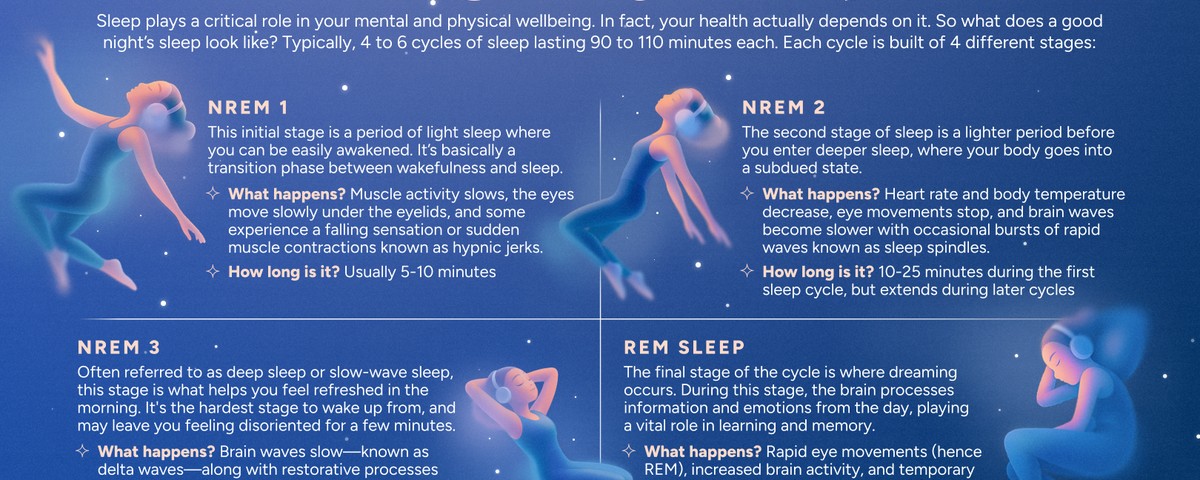
Most sleep advice stops at duration: get eight hours. That framing misses the point. Eight hours of fragmented, alcohol-disrupted, late-timed sleep is not equivalent to eight hours of consolidated, well-timed sleep. The difference lies in architecture — the specific sequence of sleep stages your brain cycles through across the night, each performing biological functions that the others cannot substitute for. This guide breaks down what those stages are, what they actually accomplish, and what the evidence says about improving each one.
The Sleep Stage Architecture
Sleep is not a single state. Your brain cycles through four distinct stages in roughly 90-minute cycles, repeating 4–6 times across a full night. An electroencephalogram (EEG) measuring electrical activity at the scalp allows researchers to identify each stage precisely by its characteristic waveform pattern.
NREM Stage 1 is the transition from wakefulness to sleep — a light, fragile state lasting a few minutes in which the brain produces theta waves (4–8 Hz) and the body begins to disengage. Muscle tone decreases, and it is during Stage 1 that hypnic jerks occur: the sudden involuntary muscle contractions that sometimes startle you awake as you fall asleep. These are a normal artifact of the nervous system transitioning between states, not a sign of pathology. Stage 1 accounts for roughly 5% of total sleep time and is not restorative in any meaningful sense — it is simply the gateway.
NREM Stage 2 is the workhorse of the night, accounting for approximately 45–55% of total sleep. Brain activity slows further, and two characteristic waveform events emerge: sleep spindles (bursts of 12–15 Hz activity lasting 0.5–3 seconds, generated by the thalamus) and K-complexes (large, sharp waveforms that appear spontaneously or in response to external stimuli). Core body temperature and heart rate continue to fall. Sleep spindles are not arbitrary — they are thought to be the mechanism by which the sleeping brain consolidates procedural memories and protects sleep continuity by inhibiting the processing of external sensory input.
NREM Stage 3 — Deep Sleep (Slow-Wave Sleep) is defined by high-amplitude, low-frequency delta waves (0.5–2 Hz) occupying at least 20% of a 30-second epoch. It is the most difficult stage to be woken from, the most sensitive to disruption, and the most consequential for physical recovery. The body is at its most physiologically restorative during this stage. Brain activity is dramatically reduced compared to wakefulness. Deep sleep is heavily concentrated in the first two 90-minute cycles of the night and tapers sharply thereafter.
REM Sleep (Rapid Eye Movement) is physiologically bizarre. Brain activity — as measured by EEG — becomes nearly indistinguishable from wakefulness, showing low-amplitude, mixed-frequency activity. The eyes move rapidly behind closed lids. The body is actively paralyzed through inhibition of motor neurons (a mechanism called REM atonia), preventing you from acting out dreams. Heart rate and breathing become irregular and variable. The vast majority of vivid, narrative dreaming occurs during REM. Unlike deep sleep, REM is distributed unevenly across the night — it is sparse in the early cycles and expands dramatically in the final ones. The last 90-minute cycle before a natural wake time may contain 45–60 minutes of REM.
A full sleep cycle is approximately 90 minutes from Stage 1 through to the end of a REM period. The composition of these cycles changes across the night: early cycles are deep-sleep-heavy, late cycles are REM-heavy. This is not random — it is the result of interacting circadian and homeostatic forces, as explained in detail in our complete guide to circadian rhythm.
What Deep Sleep Does
Deep sleep is where the majority of the body’s physical restoration occurs. Several specific mechanisms converge during slow-wave sleep that cannot operate at full capacity during other stages.
Growth hormone secretion is pulsatile and tightly coupled to slow-wave sleep. The largest single pulse of growth hormone (GH) in adult humans occurs during the first deep sleep cycle, typically within 60–90 minutes of sleep onset. GH drives tissue repair, protein synthesis, immune cell production, and fat metabolism. Disrupting the first sleep cycle — by sleeping at an abnormal time, by alcohol consumption, or by environmental disturbances — directly blunts growth hormone release in a way that cannot be compensated by later cycles.
Memory consolidation for declarative memories — the explicit, fact-based memories you can consciously recall — depends on deep sleep. The hippocampus, which acts as a temporary buffer for new memories acquired during the day, replays those memories during slow-wave sleep and transfers them to distributed cortical storage. This replay process is directly associated with the sleep spindles visible on EEG. Studies in which deep sleep was selectively suppressed (by playing tones through headphones at frequencies too quiet to fully wake the participant, but sufficient to prevent slow-wave activity) produced measurable deficits in declarative memory the following day.
The glymphatic system — the brain’s metabolic waste clearance network — operates primarily during deep sleep. This system, described formally in 2013 by Maiken Nedergaard’s team at the University of Rochester, uses cerebrospinal fluid to flush metabolic byproducts from brain tissue through channels that expand significantly during sleep. Among the molecules cleared by this process are amyloid-beta and tau — the proteins whose abnormal accumulation is associated with Alzheimer’s disease. Even a single night of sleep deprivation measurably increases amyloid-beta concentrations in the human brain. Deep sleep is not optional long-term maintenance.
How much deep sleep do you need? Healthy adults typically spend 15–20% of total sleep in deep sleep — roughly 60–90 minutes across a full night. Deep sleep declines substantially with age: by age 60, many adults obtain less than 5% of sleep as slow-wave, and by age 70, genuine Stage 3 deep sleep may be nearly absent in some individuals. This is thought to be a primary contributor to the memory difficulties and recovery impairment associated with aging.
What reduces deep sleep: Alcohol is the most potent acute suppressor. Even moderate alcohol (two standard drinks in the 3 hours before bed) fragments slow-wave sleep in the second half of the night and blunts growth hormone release. Poor sleep hygiene that fragments sleep continuity (ambient noise, light, inconsistent timing) reduces the probability of sustaining the deep, uninterrupted sleep episodes required for full slow-wave expression. Aging is the unavoidable structural factor.
What REM Sleep Does
If deep sleep is physical restoration, REM is psychological and neurological restoration. The functions attributed to REM — many now supported by direct experimental evidence — are primarily cognitive and emotional.
Emotional memory processing is one of REM’s most studied functions. Research from Matthew Walker’s laboratory at UC Berkeley established that REM sleep — specifically the neurochemical state of REM (characterized by absence of noradrenaline, the brain’s stress neuromodulator) — allows the brain to replay emotionally salient memories while stripping their emotional intensity. This “overnight therapy” effect means that events feel less emotionally charged after a night of adequate REM. REM-deprived individuals re-exposed to emotionally negative images show exaggerated amygdala reactivity compared to those with intact REM, and the link between REM disruption and anxiety and mood disorders is well-established in the clinical literature.
Procedural and creative memory consolidation takes place during REM, distinct from the declarative consolidation of deep sleep. Motor skill learning — playing an instrument, a sport, a new physical task — shows the most improvement following REM-rich sleep. Creative insight also has a documented REM dependency: subjects in studies by researchers including Ullrich Wagner showed roughly threefold improvements in the ability to identify hidden mathematical rules after a full night of sleep compared to an equivalent period of wakefulness — an effect that tracked with REM duration.
Synaptic homeostasis — the brain’s mechanism for maintaining optimal neural signal-to-noise by selectively pruning and strengthening synaptic connections — is thought to occur substantially during REM sleep, though the precise mechanism is still being characterized. The hypothesis (synaptic homeostasis hypothesis, SHY) proposes that wake experience saturates synaptic strength, and sleep — particularly REM — downscales this saturation to restore selectivity.
How much REM do you need? Healthy adults spend roughly 20–25% of total sleep in REM — approximately 90–120 minutes across a full night. Because REM is back-loaded, this total is acutely vulnerable to early wake times. Cutting an 8-hour sleep to 6 hours does not reduce REM proportionally — it reduces it dramatically, because the 2 hours lost are the 2 hours most densely packed with REM.
What reduces REM: Alcohol is again the primary suppressor. Even moderate alcohol dramatically suppresses REM in the first half of the night, and the rebound REM in the second half — which comes with bizarre, disturbing dreams as the REM system re-asserts itself — is fragmented and less restorative than undisturbed REM. Cannabis (specifically THC) is a potent REM suppressor; regular users show severely blunted REM, and the vivid, disturbing dreams experienced during cannabis cessation reflect months of accumulated REM rebound. Several common medications — SSRIs, SNRIs, tricyclic antidepressants, some blood pressure medications — also substantially suppress REM.
Deep Sleep vs REM: Which Matters More?
This is the wrong question. Deep sleep and REM are not competing — they are complementary, and deprivation of either produces distinct and non-overlapping deficits.
Deep sleep deprivation impairs: physical recovery and tissue repair, growth hormone release, immune function, declarative memory, and glymphatic clearance. The consequences are most visible in physical performance — athletes with disrupted deep sleep show degraded strength, reaction time, and injury recovery — and in long-term cognitive health through accumulated amyloid burden.
REM deprivation impairs: emotional regulation, procedural learning, creative problem-solving, and psychological resilience. The consequences are most visible in mood — even one night of selective REM suppression increases next-day irritability, anxiety sensitivity, and the probability of interpreting neutral faces as threatening.
Both are essential. The practically useful distinction is understanding that they are vulnerable to different disruptors and occur at different times of the night — which means different interventions are required to protect each one.
How to Get More Deep Sleep
Sleep timing consistency is the most structural lever. Because deep sleep is homeostatic-pressure-driven and front-loaded, it is most reliably obtained when you go to bed at roughly the same time each night, allowing Process S (adenosine accumulation) to peak at the moment of sleep onset. Sleeping at inconsistent times produces inconsistent sleep pressure at bedtime.
Cool bedroom temperature facilitates the core body temperature drop that enables and sustains deep sleep. A bedroom temperature of 65–68°F (18–20°C) is the most consistently recommended range. Research on sleep surface cooling (devices like Eight Sleep that allow temperature to drop during the first half of the night) has shown measurable improvements in slow-wave sleep percentage. Full detail on temperature optimization is in our bedroom temperature guide.
Aerobic exercise is one of the few interventions with consistent evidence for increasing slow-wave sleep amount. The mechanism is not fully characterized but appears to relate to increased adenosine production during exercise and a greater homeostatic sleep pressure at bedtime. The effect is dose-dependent and typically requires consistent exercise over weeks rather than showing up the night after a single session.
Eliminating alcohol — even moderate amounts — is among the highest-impact changes a person can make to their deep sleep quality. The data is not subtle: alcohol-facilitated unconsciousness in the first half of the night resembles deep sleep on surface metrics but lacks the characteristic delta oscillations and growth hormone pulsatility of genuine slow-wave sleep.
Magnesium (particularly magnesium glycinate or threonate) has some evidence for supporting slow-wave sleep, possibly through its role in GABA receptor modulation. The effect size is modest in most studies but the safety profile is strong. Other supplements (glycine, theanine, ashwagandha) have limited but promising preliminary evidence.
How to Get More REM Sleep
Sleep longer. This is the bluntest and most effective advice. Because REM is concentrated in the final cycles of the night, the most reliable way to increase REM is to allow sleep to run to its natural conclusion rather than terminating it with an alarm. Even extending sleep by 30–60 minutes can meaningfully increase REM exposure.
Protect your second and third sleep cycles. Alarms set too early — or multiple alarms that allow you to return to light sleep — interrupt the REM-dominant second half of the night. If a single wake time is necessary, set it once and accept it. The habit of setting an alarm 30 minutes before you need to wake up and snoozing repeatedly produces lighter, more fragmented sleep in the exact window richest in REM.
Eliminate alcohol and cannabis use near bedtime. These are the two most potent and most commonly encountered REM suppressors. The mechanism is pharmacological and not subject to habituation tolerance in the way that some effects are — chronic users still show blunted REM even after months of use.
Tracking Your Sleep Stages
Consumer sleep trackers — wrist-worn accelerometers with optical heart rate sensors, or EEG-based headbands — can provide useful longitudinal data on sleep staging. It is important to understand what they actually measure.
Wrist-based devices (Oura Ring, Garmin, Apple Watch, WHOOP) infer sleep stages from heart rate variability, movement, and skin temperature. They do not directly measure brain activity. Studies benchmarking these devices against laboratory polysomnography (PSG) — the clinical gold standard — find that they perform reasonably well for identifying sleep vs. wake and total sleep duration, but show meaningful stage-misclassification rates, particularly for distinguishing deep sleep from light NREM. Their accuracy for light sleep vs. deep sleep is roughly 60–70% at the epoch level.
What this means practically: do not obsess over individual night staging data. The numbers on a given night may be wrong. What is reliable is the trend across weeks and months — whether your overall deep sleep and REM percentages are moving in the right direction in response to behavioral changes. Use the data to assess the direction of change, not as a precise diagnostic tool. Our review of the best sleep trackers in 2026 includes accuracy benchmarks from independent validation studies.
An important note on orthosomnia — anxiety about sleep tracking data that itself disrupts sleep — has been documented in the clinical literature. If checking your tracker numbers creates stress, the net effect may be negative. Track to learn, not to judge.
Key Takeaways
- Sleep cycles through four stages — NREM 1, NREM 2, deep (NREM 3), and REM — in roughly 90-minute cycles. A full night contains 4–6 cycles.
- Deep sleep dominates the first half of the night and is physically restorative: growth hormone release, glymphatic clearance, immune function, and declarative memory consolidation all depend on it.
- REM dominates the second half and is neurologically restorative: emotional processing, procedural learning, creative consolidation, and psychological resilience all depend on it.
- Cutting sleep short by 1–2 hours disproportionately destroys REM because the lost time comes from the most REM-dense part of the night.
- Alcohol is the most common and most potent suppressor of both stages — it fragments slow-wave sleep and blunts REM simultaneously.
- Cool bedroom temperature, consistent timing, and aerobic exercise are the highest-leverage behavioral tools for increasing deep sleep.
- More total sleep time — specifically protecting the final cycles of the night — is the most direct way to increase REM.
- Consumer sleep trackers are reliable for trends across weeks, not precise night-by-night staging. Do not optimize for the number; optimize for the behavior.