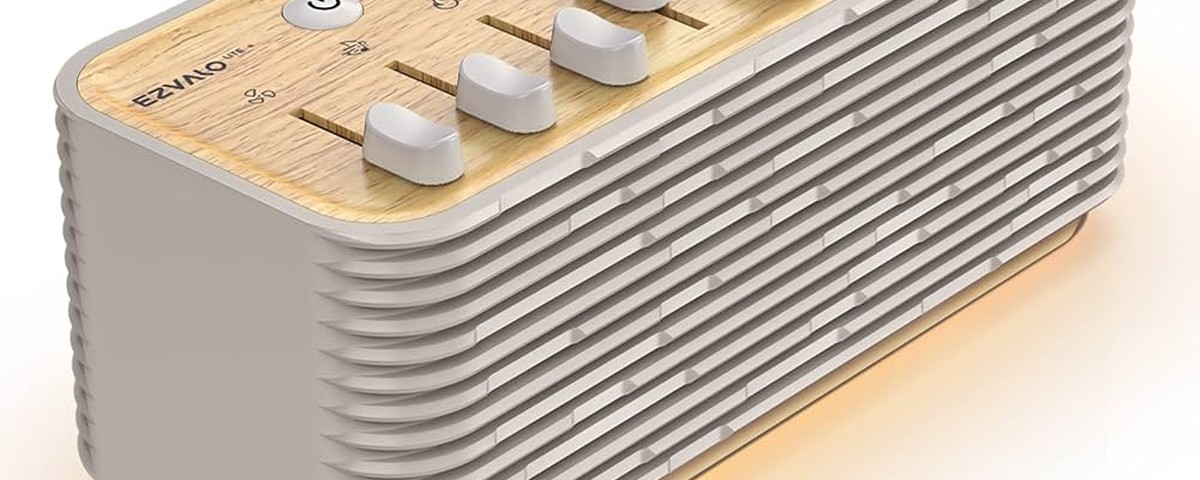
White noise machines occupy a curious corner of the sleep market. On one hand, millions of people swear by them — parents who can’t imagine putting a baby to sleep without one, shift workers who use them to block afternoon traffic noise, and city dwellers who run one every night without a second thought. On the other hand, critics suggest the research is thinner than the marketing implies, and some sleep scientists have raised questions about long-term use.
So what does the evidence actually say? The honest answer is nuanced — white noise clearly helps some people in some situations, but it’s not a universal sleep solution and it comes with genuine caveats worth understanding.
What White Noise Is (and Why People Use It)
White noise is a specific type of sound that contains all audible frequencies — from 20 Hz to 20,000 Hz — played simultaneously at equal intensity. The name is borrowed from white light, which contains all wavelengths of the visible spectrum. The result is a steady, static-like hiss that many people find neutral or mildly soothing.
People use white noise primarily for one reason: sound masking. The goal isn’t to lull you to sleep with a pleasant sound — it’s to create an acoustic buffer that prevents disruptive noises from reaching your sleeping brain at high enough contrast to cause arousal.
The Science: How Your Brain Processes Sound During Sleep
Your auditory cortex never fully goes offline during sleep. While consciousness fades, your brain continues monitoring the environment for sounds that might signal danger — an evolutionary holdover from a time when rustling in the dark had lethal implications. This vigilance is what makes a sleeping parent bolt upright at their infant’s cry while sleeping through a thunderstorm.
The mechanism that wakes you isn’t absolute volume — it’s acoustic contrast. A sudden sound that is significantly louder than the ambient baseline triggers an arousal response far more reliably than a steady loud sound. A car alarm in a silent room is vastly more disruptive than the same car alarm in a room already filled with moderate noise.
White noise works by raising the ambient acoustic floor of your environment. When the baseline noise level is higher, a sudden intrusive sound — a door slam, a passing truck, a partner’s phone — represents less of a contrast spike, and is less likely to trigger an arousal or full awakening.
White, Pink, and Brown Noise: What’s the Difference?
Not all noise colors are equal, and the differences matter for sleep applications.
White noise distributes equal energy across all frequencies. Because higher frequencies carry more energy per octave at equal amplitude, white noise sounds distinctly bright and hissy — like a detuned radio or rushing air through a vent. Some people find it harsh over long periods.
Pink noise decreases in power as frequency increases, following a 1/f pattern. The result sounds softer and more natural — closer to rainfall or a gentle waterfall. Pink noise has attracted significant research attention as a sleep aid in its own right (not just for masking). A 2017 study in Frontiers in Human Neuroscience found that pink noise synchronized to slow-wave sleep enhanced memory consolidation in older adults. A 2012 study in the Journal of Theoretical Biology reported improved slow-wave sleep with pink noise exposure.
Brown noise (also called red noise) drops even more steeply with frequency, producing a deep, rumbling sound — think a strong river current or low-frequency wind. Many people find brown noise the most relaxing of the three, and it has become popular on platforms like YouTube and Spotify, though formal sleep research on it specifically is more limited.
For pure sleep quality and memory consolidation, pink noise has the strongest evidence base. For sound masking (the original use case), white noise’s even frequency distribution may provide slightly broader coverage. Brown noise is the best choice for people who find the higher frequencies of white and pink noise irritating.
What the Research Actually Says
The research on white noise and sleep is promising but not ironclad. Key findings:
- A 2005 study in the Journal of Advanced Nursing found that white noise significantly reduced sleep onset time and nighttime awakenings in cardiac patients in an ICU setting — a particularly noisy environment.
- A 2021 review in Sleep Medicine Reviews concluded that noise-masking interventions improved sleep in hospital settings but noted the evidence was weaker for healthy adults in typical home environments.
- Multiple studies on pink noise specifically show enhancement of slow-wave sleep and associated memory benefits, though most used targeted delivery (synchronized to sleep stages) rather than continuous background noise.
- A 2022 study raised the concern that continuous white noise may actually impair auditory cortex development in infants with prolonged exposure — an important caveat for parents.
The takeaway: white and pink noise work best as a masking solution in noisy environments. For people already sleeping in quiet conditions, the added benefit is modest.
Who Benefits Most
The people who see the clearest, most reliable benefit from white noise are:
- Light sleepers who wake at minor disturbances and struggle to return to sleep
- City dwellers dealing with irregular traffic, voices, or nightlife noise
- People with tinnitus — the steady external sound can partially mask ringing, making sleep onset easier
- Infants and young children — white noise mimics the acoustic environment of the womb and is widely used in pediatric sleep protocols (though volume should be kept under 50 dB)
- Shift workers sleeping during the day, when ambient household and outdoor noise is highest
- People sharing a sleep space with a partner who snores lightly or moves frequently
Potential Downsides
White noise is not consequence-free, and honest coverage requires addressing the risks:
Volume is critical. The sleep benefit of white noise is real, but only at moderate volumes — roughly 50–65 dB. At higher volumes (65+ dB), research suggests noise exposure during sleep can itself fragment sleep architecture and has been linked to cardiovascular stress in long-term studies. Never put a white noise machine directly next to a baby’s ear or run it at its maximum volume.
Acoustic dependency. Some regular users find they cannot sleep without their white noise machine when traveling. This isn’t dangerous, but it’s worth being aware of — the psychological reliance can become an obstacle in settings where the machine isn’t available.
Masking important sounds. A white noise machine running at sufficient volume can mask smoke alarms, carbon monoxide detectors, a child calling out, or an intruder. Position machines thoughtfully, ensure alarm systems are loud enough to penetrate, and consider whether full masking is appropriate for your specific situation.
Possible infant auditory development concerns. As noted above, prolonged exposure to continuous white noise in early infancy is an evolving area of concern. Current pediatric guidance recommends limiting duration and keeping volume below 50 dB.
White Noise vs. Nature Sounds vs. Silence
For people without significant noise intrusion problems, the choice between white noise and nature sounds (rain, ocean, forest) often comes down to personal preference, and both appear equally capable of improving subjective sleep quality in quiet environments.
Silence remains the gold standard for people who already sleep in genuinely quiet conditions. The brain doesn’t need acoustic stimulation to sleep well — it needs the absence of disruptive stimulation. If you can achieve that with silence, there’s no evidence that adding noise improves sleep further.
For people with noisy environments or tinnitus, white or pink noise consistently outperforms silence on objective sleep measures. For relaxation and sleep onset in moderate-noise environments, nature sounds may have a slight edge due to their psychological associations with calm — though the masking ability is somewhat weaker.
How to Choose a White Noise Machine
Key features to evaluate: volume range, frequency quality (cheaper machines loop short audio clips, creating subtle rhythmic patterns the brain can detect), the availability of pink and brown noise in addition to white, timer functions, and portability. Our comprehensive review of the best white noise machines covers the top options across price points. For most people, the SNOOZ White Noise Machine{rel=“nofollow sponsored” target=“_blank”} hits the best balance of sound quality, volume range, and value.
The Fan Alternative: Is Sleeping with a Fan Bad?
Many people use a box or ceiling fan as a budget white noise machine — and it works, with some caveats. A fan produces broadband noise that effectively masks light intrusions. The downsides: fans can cool the room excessively (though often this is a feature, not a bug), can dry out nasal passages and skin with prolonged use, and the noise profile changes with fan speed in ways that may not suit all sleepers. For most people, sleeping with a fan is perfectly fine. It becomes a problem primarily for people who run cold or have respiratory sensitivity to dry air.
Key Takeaways
- White noise works through sound masking, reducing acoustic contrast spikes that trigger nighttime arousals.
- It is most beneficial in noisy environments — less so for people already sleeping in quiet conditions.
- Pink noise has the strongest evidence for enhancing slow-wave sleep and memory consolidation; brown noise is preferred by many for its deeper, less harsh tone.
- Volume should be kept at 50–65 dB — high enough to mask but not high enough to become its own disruptor.
- Main beneficiaries: light sleepers, city dwellers, tinnitus sufferers, infants, and shift workers.
- Real downsides exist: acoustic dependency, volume risks, and masking of safety alarms warrant careful consideration.
- A basic fan is a legitimate, low-cost alternative for mild noise masking needs.