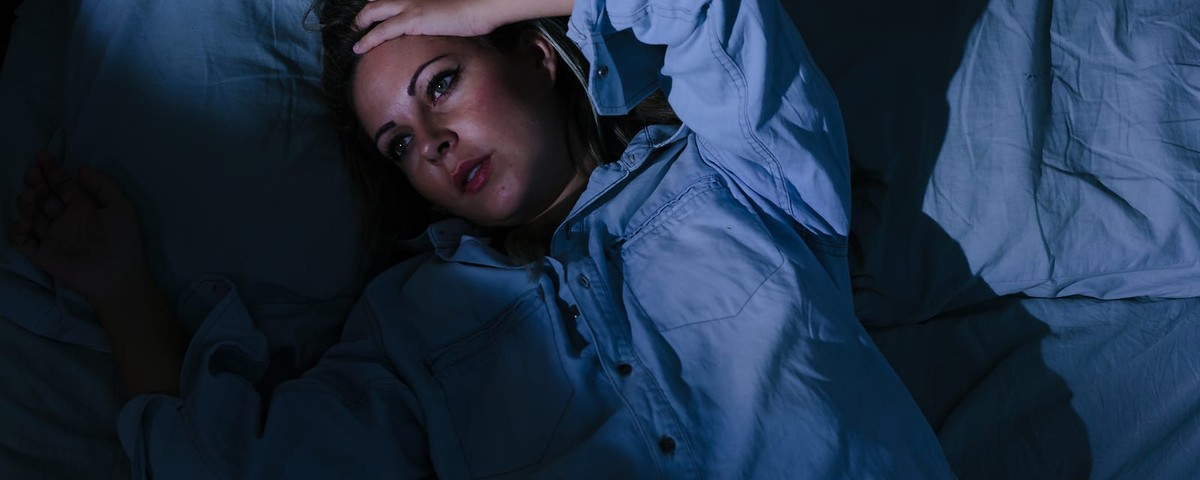
You make it through the day — busy, distracted, functional — and then you lie down. The room goes quiet. And suddenly your mind starts doing the opposite of what you need it to do. The worries come flooding in. The mental replays of awkward conversations from three weeks ago. The catastrophizing about tomorrow. Your chest tightens. Sleep feels impossibly far away.
If this is your nightly experience, you’re in extremely common company. Nighttime anxiety — the kind that specifically ramps up when you try to sleep — is one of the most frequently reported sleep complaints, and it sits at the intersection of two very well-studied phenomena that reinforce each other. Understanding why it happens at night, specifically, is the first step toward breaking the cycle.
Why Anxiety Gets Worse at Night
During the day, your brain is occupied. Tasks, conversations, movement, and sensory input all compete for attentional resources, giving the anxious mind less space to operate. The clinical term for this is attentional load — the degree to which your conscious mind is engaged with the external world. When that load drops to near zero as you lie quietly in a dark room, the brain doesn’t simply switch off. It switches inward.
This is compounded by a biological shift. As your body prepares for sleep, it undergoes a series of physiological transitions — core body temperature drops, melatonin rises, heart rate slows. These changes are supposed to feel calming, but for people in a state of chronic stress or anxiety, the very act of the nervous system downshifting can feel destabilizing. The absence of stimulation doesn’t feel like peace. It feels like exposure.
There’s also the matter of perceived control. During the day, there are things to do — problems to address, emails to send, plans to make. At night, there is nothing. The things that worry you are still there, but your capacity to act on them is entirely suspended. For the anxiety-prone mind, this gap between threat and action is deeply uncomfortable.
The Neuroscience Behind It
Three neurological systems are particularly relevant to understanding nighttime anxiety.
Cortisol follows a daily arc, peaking about 30–45 minutes after waking and declining throughout the day. But in people under chronic stress, this rhythm can become dysregulated — cortisol stays elevated into the evening or fails to drop fully before bed. Since cortisol is inherently activating (it primes the brain and body for response), elevated evening cortisol keeps your arousal system switched on precisely when it needs to be switching off.
Norepinephrine, the fight-or-flight neurotransmitter, is also relevant. Anxiety disorders and chronic stress are associated with elevated norepinephrine tone, which increases vigilance and makes the nervous system reactive to small stimuli — a sound, a passing thought, a physical sensation. At night, when external distractions disappear, internal stimuli (thoughts, bodily sensations, the sound of your own heartbeat) become much more prominent. A hyperresponsive norepinephrine system interprets these as threats.
Then there’s the default mode network (DMN) — a set of brain regions that become more active when we’re not focused on the external world. The DMN is associated with self-referential thinking, mental time travel (replaying the past or projecting into the future), and narrative construction. It is, in short, the part of the brain responsible for rumination. It activates strongly at bedtime, when external demands disappear. In anxious individuals, the DMN tends to be hyperactive, and its outputs tend to skew negative.
The Main Causes of Nighttime Anxiety
1. Hyperarousal from Daily Stress
Stress accumulated during the day doesn’t automatically dissipate at bedtime. If your nervous system has been in a state of low-grade activation all day — meetings, deadlines, difficult interactions, scrolling through unsettling news — it doesn’t simply reset when you lie down. The physiological signature of stress (elevated cortisol, heightened sympathetic nervous system activity, a primed threat-detection system) persists into the evening hours.
Chronic hyperarousal is one of the defining features of clinical insomnia, and it’s also the primary mechanism linking daytime anxiety to nighttime sleep disruption. The more days in a row your nervous system runs hot, the harder it becomes for it to downshift at night.
2. Rumination and Cognitive Arousal
Rumination — repetitive, passive focus on distress and its possible causes and consequences — is cognitively activating in a way that’s directly incompatible with sleep onset. It keeps the prefrontal cortex engaged, maintains emotional arousal, and signals to the brain that there is unfinished business that demands attention.
People who ruminate heavily at night often describe lying in bed with their minds “spinning” — unable to stop thinking even when they recognize that thinking is not helping. This isn’t a character flaw or a lack of willpower. It’s a trained cognitive habit that can be untrained.
3. Screen Light and Melatonin Suppression
Melatonin — the hormone that signals darkness and initiates the cascade of physiological changes associated with sleep — is highly sensitive to light, particularly short-wavelength blue light. Screens (phones, tablets, televisions, laptops) emit substantial amounts of blue light, and evening exposure delays melatonin onset by 1–3 hours depending on intensity and duration.
This matters for anxiety specifically because melatonin isn’t just a sleep hormone. It has direct anxiolytic (anti-anxiety) properties. It modulates GABA receptors, reduces amygdala reactivity, and promotes a general sense of calm. When melatonin is suppressed by late-night screen use, you lose not just a sleep cue but a biochemical buffer against anxiety.
4. Caffeine and Stimulants
Caffeine’s half-life is approximately 5–7 hours — meaning half of a 3PM coffee is still circulating in your bloodstream at 9 or 10PM. Caffeine works by blocking adenosine receptors; adenosine is the molecule that accumulates throughout the day and builds sleep pressure. When caffeine blocks it, sleep pressure is masked — but as caffeine clears, there’s a rebound effect. The adenosine floods back, but by then the circadian timing for sleep may have passed. The result is a paradoxical combination of physical fatigue and mental restlessness.
Pre-workout supplements, some teas, chocolate, and many medications also contain stimulants that can disrupt the evening wind-down.
5. Irregular Sleep Schedule and Circadian Disruption
Your circadian rhythm doesn’t just govern sleepiness — it regulates the daily rhythm of anxiety-related neurotransmitters and hormones. An irregular sleep schedule confuses these rhythms, producing a kind of internal jet lag that can express itself as evening anxiety, difficulty falling asleep, and mood dysregulation.
Sleeping late on weekends (common in shift workers and night owls with early work schedules) is particularly disruptive. Even two days of schedule irregularity per week is enough to measurably shift circadian phase and increase anxiety in the evenings of the following week.
6. Underlying Anxiety Disorders
For some people, nighttime anxiety isn’t a lifestyle-driven problem but the expression of a clinical anxiety disorder — generalized anxiety disorder (GAD), panic disorder, or PTSD, among others. Sleep disturbance is a diagnostic criterion for GAD, and panic attacks that occur specifically at night are a recognized and treatable variant of panic disorder.
If anxiety is severely disrupting your sleep on most nights, is associated with significant distress, or has persisted for months despite lifestyle changes, it’s worth speaking with a mental health professional.
Practical Solutions
Try a weighted blanket. The distributed weight activates deep pressure stimulation — the same mechanism behind being held or swaddled — which increases serotonin and reduces cortisol. For anxiety-driven sleep problems specifically, a weighted blanket{rel=“nofollow sponsored” target=“_blank”} is one of the most evidence-backed physical interventions available.
Build a genuine wind-down routine. The hour before bed should be genuinely low-stimulation — not just “not looking at your phone as much.” Dim the lights, take a warm shower or bath (the subsequent drop in core body temperature signals sleep), do something calm and absorbing. A consistent bedtime routine works partly because it becomes a conditioned cue for sleep, but also because it actively lowers cortisol and nervous system activation.
Try physiological sighing. This is a double inhale through the nose followed by a long, slow exhale through the mouth. Two or three of these is one of the fastest known ways to reduce acute anxiety — it deflates the alveoli in the lungs, resets breathing mechanics, and activates the parasympathetic nervous system. Research from Stanford has validated its effectiveness.
Use box breathing or 4-7-8 breathing. Box breathing (inhale 4 counts, hold 4, exhale 4, hold 4) is used by Navy SEALs to reduce acute stress. The 4-7-8 technique (inhale 4, hold 7, exhale 8) is particularly well-suited to bedtime because the long exhale activates the vagus nerve and parasympathetic system.
Reduce cognitive arousal with a worry journal. Write down your worries and a brief note on what, if anything, you can do about them. This simple act of externalizing concerns — essentially telling your brain “I have acknowledged this and assigned it a time” — reduces rumination at night. Research has also found that writing a to-do list for tomorrow reduces bedtime cognitive arousal more than journaling about completed tasks.
Manage your sound environment. Silence isn’t always calming — especially for anxious minds, where quiet can feel exposing. A white noise machine or gentle ambient sound can occupy just enough of the auditory cortex to reduce the signal-to-noise ratio for anxious thoughts. The SNOOZ White Noise Machine{rel=“nofollow sponsored” target=“_blank”} uses a real fan motor rather than looped audio, producing a more natural, consistent tone that many anxious sleepers find easier to settle with. See our full white noise machine guide for more options.
Cut off screens 60–90 minutes before bed. If this feels impossible, use night mode, blue-light-blocking glasses{rel=“nofollow sponsored” target=“_blank”}, and reduce screen brightness to its lowest setting. Blocking blue light in the 2–3 hours before bed meaningfully preserves melatonin onset even with screen exposure.
Key Takeaways
- Nighttime anxiety is not a personal failing. It has specific neurological causes: elevated cortisol, heightened norepinephrine tone, and default mode network hyperactivation when external demands disappear.
- Melatonin is both a sleep hormone and an anxiolytic. Screen use before bed doesn’t just delay sleep — it removes a biochemical buffer against anxiety.
- Caffeine consumed in the afternoon can still be driving anxiety at bedtime due to its 5–7 hour half-life.
- A consistent wind-down routine — light dimming, low stimulation, calming activity — directly reduces physiological arousal and conditions the brain for sleep.
- Breathing techniques (physiological sigh, box breathing, 4-7-8) are evidence-based, fast-acting interventions for acute nighttime anxiety.
- If nighttime anxiety is severe or persistent, it may reflect an underlying anxiety disorder and warrants professional evaluation. CBT for insomnia and CBT for anxiety are both highly effective and often work best in combination.