Overview
Waking up with a dry, sticky, or sore mouth is something most people experience at some point — but for many, it is a nightly occurrence that quietly chips away at sleep quality and oral health.
The medical term is xerostomia (pronounced zero-STOH-mee-ah): a subjective sensation of oral dryness. It is worth noting that some reduction in saliva production is entirely normal during sleep. The body down-regulates saliva output as part of the autonomic shift into sleep, partly because the swallowing reflex slows and partly to avoid excessive saliva during a period when you are not eating. You wake with a slightly dry mouth most mornings without it being a problem.
What is not normal is waking with a mouth so dry that the tongue sticks to the palate, the lips are cracked, or there is a persistent bad taste or soreness. That level of dryness signals that something is significantly accelerating the drying process overnight.
Main Causes
1. Mouth Breathing
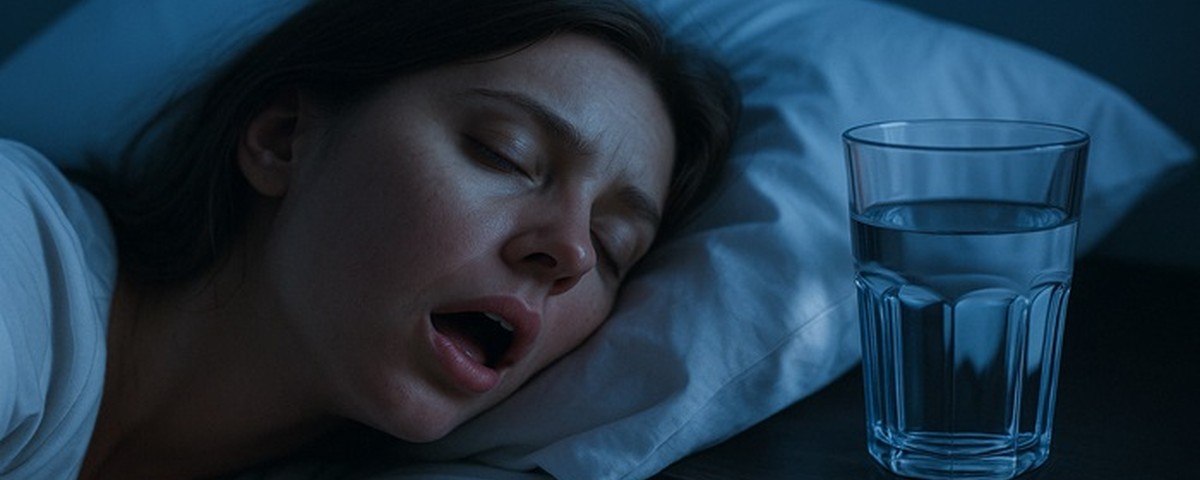
Mouth breathing during sleep is the single most common cause of morning dry mouth, and the logic is simple: the mouth is not designed as a primary breathing airway. The nasal passages warm, humidify, and filter incoming air; the mouth does none of these things. Air passing over the soft tissues of the mouth and throat all night long evaporates moisture at a much faster rate than nasal breathing.
Mouth breathing during sleep also tends to produce snoring, slightly reduces sleep quality (due to less efficient gas exchange and greater airway resistance), and can dry out the throat and even the lungs over time.
The most common reason adults switch to mouth breathing at night is nasal congestion — from allergies, a cold, a deviated septum, or nasal polyps. Anatomical factors such as a high, narrow palate can also play a role.
2. Sleep Apnea
Sleep apnea and dry mouth are strongly associated — so much so that waking with a dry mouth is listed as a clinical symptom of obstructive sleep apnea (OSA) in diagnostic guidelines.
The connection works like this: when the upper airway collapses or narrows during apnea, the body’s automatic response is to shift to mouth breathing to compensate. The jaw falls open, air bypasses the nose, and the mouth dries out over the course of hundreds of these micro-events throughout the night. Many people with sleep apnea wake with an intensely dry mouth and do not connect the two.
If your dry mouth is accompanied by heavy snoring, waking with a gasp, unrefreshing sleep, or daytime fatigue, it is worth investigating for sleep apnea.
3. Medications
A wide range of commonly prescribed and over-the-counter medications list dry mouth as a side effect. The most frequently implicated categories include:
- Antihistamines (cetirizine, loratadine, diphenhydramine) — especially first-generation antihistamines used as sleep aids
- Antidepressants — particularly tricyclics and SSRIs, though most classes can cause it
- Decongestants (pseudoephedrine, phenylephrine)
- Diuretics — reduce overall fluid volume
- Anticholinergics — used for bladder conditions, COPD, and some gastrointestinal issues
- Blood pressure medications — some beta-blockers and ACE inhibitors
- Muscle relaxants
If you recently started a new medication and noticed dry mouth appearing or worsening soon after, medication is very likely the cause. Never stop a prescribed medication without consulting your doctor, but it is worth raising the issue — alternative formulations or dosing times may reduce the effect.
4. Dehydration
Saliva production depends on adequate total body hydration. If you arrive at bedtime already mildly dehydrated — something that is easy to do if you have been active, had caffeine or alcohol, or simply not drunk enough water during the day — the body’s reduced fluid availability will make the normal overnight dip in saliva production feel much more extreme.
5. Alcohol
Alcohol contributes to morning dry mouth through two mechanisms. First, it is a diuretic: it suppresses antidiuretic hormone (ADH), causing you to produce more urine and lose more fluid than you take in, leading to net dehydration overnight. Second, alcohol relaxes the muscles of the throat and jaw, promoting mouth breathing and sometimes outright apnea in people who otherwise do not have it.
The combination of dehydration and open-mouth breathing for hours is a reliable formula for an extremely dry, uncomfortable mouth by morning.
6. Low Bedroom Humidity
The drying power of your sleeping environment is often underestimated. In winter, central heating dramatically reduces indoor relative humidity — sometimes to 20–30%, levels drier than many deserts. At these humidity levels, moisture evaporates from mucosal surfaces much faster, regardless of whether you breathe through your nose or mouth.
Even nasal breathers can wake with a dry mouth and irritated nasal passages in a very dry room. This is especially relevant in climates with harsh winters or in homes with forced-air heating systems.
7. Sjögren’s Syndrome and Autoimmune Conditions
Sjögren’s syndrome is an autoimmune condition in which the immune system attacks the glands that produce saliva and tears. The hallmark symptoms are persistent dry mouth (not just on waking) and dry eyes. It affects roughly 4 million Americans, the vast majority of them women, and is frequently undiagnosed for years.
Other autoimmune and systemic conditions that can cause or worsen dry mouth include lupus, rheumatoid arthritis, diabetes (particularly poorly controlled), and HIV/AIDS. If your dry mouth persists throughout the day — not just on waking — and is accompanied by dry eyes or joint pain, a systemic cause is worth investigating.
Consequences of Chronic Dry Mouth
Saliva is not just a lubricant. It plays a critical role in oral health that most people do not appreciate until it is gone:
- Dental cavities: Saliva neutralises acids produced by oral bacteria and washes them from tooth surfaces. Without adequate saliva, acid levels rise and cavities develop more rapidly, particularly at the gum line.
- Bad breath (halitosis): Bacteria proliferate faster in a dry environment. An anaerobic bacterial overgrowth by morning is a direct consequence of prolonged dryness overnight.
- Oral thrush: Candida albicans naturally lives in the mouth but is kept in check by saliva’s antimicrobial proteins. Chronic dry mouth can allow candida to overgrow, causing a white coating on the tongue and inner cheeks.
- Difficulty swallowing and speaking: In severe cases, the lack of lubrication makes swallowing foods — particularly dry ones — painful and difficult.
Solutions
Nasal strips and mouth tape: If mouth breathing is the root cause, addressing it directly is the priority. Adhesive nasal dilator strips (such as Breathe Right) physically widen the nasal passages. For those who can breathe through the nose but habitually open their mouth during sleep, mouth tape{rel=“nofollow sponsored” target=“_blank”} is a simple, inexpensive solution — a small strip of porous tape over the lips gently encourages nasal breathing overnight without blocking airflow. Over time, consciously practising nasal breathing during the day helps retrain the default breathing pattern at night.
Humidifier for the bedroom: A cool-mist or warm-mist humidifier targeting 40–50% relative humidity in the bedroom is one of the simplest and most impactful interventions for dry mouth. The effect is noticeable within the first few nights. This is particularly worthwhile during winter months when indoor heating is running. Check price on Amazon →{rel=“nofollow sponsored” target=“_blank”}
Hydration before bed: Drink 1–2 glasses of water in the 1–2 hours before bed. Avoid the common trap of skipping evening fluid intake to reduce nighttime urination — moderate hydration before bed does not significantly increase bathroom trips for most people, but dramatically improves salivary comfort overnight.
CPAP therapy for sleep apnea: If sleep apnea is the underlying driver of the mouth breathing and dry mouth, CPAP (Continuous Positive Airway Pressure) therapy addresses the root cause directly. By keeping the airway open, CPAP eliminates the compensatory mouth breathing. Many CPAP users report dramatic improvement in morning dry mouth within the first week of treatment. If you suspect sleep apnea, using a sleep tracker that monitors breathing patterns can be an informative first step before pursuing a formal sleep study.
Medication review with your doctor: If medication is a likely culprit, discuss alternatives with your prescriber. Sometimes switching to a different drug in the same class, adjusting the timing of the dose (taking it in the morning rather than at night), or adding a saliva substitute can make a significant difference.
Oral hydration products: Biotène and similar products (mouth sprays, gels, and toothpastes) are specifically formulated to mimic the lubricating properties of saliva and provide short-term relief. They are useful as a stopgap but do not address any underlying cause.
When to See a Doctor
See a doctor if:
- Dry mouth persists throughout the day and is not limited to mornings
- You have noticeable dry eyes alongside dry mouth (possible Sjögren’s syndrome)
- Dry mouth appeared shortly after starting a new medication
- You have signs of sleep apnea (snoring, witnessed apneas, excessive daytime sleepiness)
- You are developing more dental cavities than usual despite good hygiene
- You notice a white coating on the tongue that does not brush away easily (possible oral thrush)
Key Takeaways
- Mouth breathing is the most common cause of morning dry mouth — finding and addressing the reason for the mouth breathing (congestion, sleep apnea, anatomical factors) is the priority.
- Sleep apnea is a frequently missed driver; dry mouth on waking is a recognised clinical symptom.
- Medications — particularly antihistamines, antidepressants, and decongestants — are another major cause that is often overlooked.
- Low bedroom humidity in winter significantly worsens dryness, even for nasal breathers. A humidifier is a simple and effective fix.
- Chronic dry mouth carries real oral health consequences — increased cavity risk, bad breath, and susceptibility to oral thrush.
- If dry mouth persists throughout the day or is accompanied by dry eyes, see a doctor to rule out systemic causes like Sjögren’s syndrome.